
When welding metal frames for chairs, armchairs and benches, the joint is sometimes part of the appearance, sometimes part of the strength, and often both at once. That is why we choose the method for each specific joint: we look at whether the weld will stay visible or disappear under the seat, and what load it has to carry.
We work with carbon steel and stainless steel. The whole frame is made in our factory, from tube bending to powder coating, so welding and joining is simply one step in the manufacturing process.
Welding metal frames: robots for series, welders for difficult joints
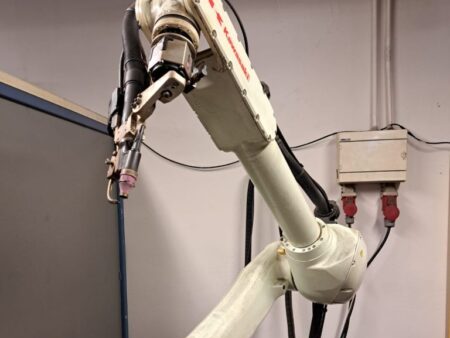
In large series, Kawasaki (TIG) and ABB (MAG) robots do the work, both on top-of-the-line Fronius welding power sources. We implemented our first robotic welding of frames in-house more than a decade ago. We program the robots ourselves; the owners and management are engineers.
A robot delivers a repeatability that cannot be achieved any other way across thousands of parts. Thanks to our own programming experience, we also know what a robot welds well and what is better left to a welder.
There are, however, frames that only an experienced person can weld well. The bent parts used in furniture frames are not as precise as CNC-machined components, so two tube sections to be joined rarely fit together perfectly. A trained welder sees what is in front of them and can compensate for the inaccuracy of the parts. On top of that, a tube-to-tube weld is usually hard to describe: along the way it changes from a fillet weld to a butt weld, in geometries that are not easy to define.
In addition, the welds often sit where other parts of the frame restrict access, so a robot cannot always lay them correctly.
Skill has another advantage that is visible to the naked eye. Experienced welders reduce the pronounced scaling of the bead, the “stack of dimes” look known from welding videos online, so our welds are smoother and more consistent.
Our welders have years of experience with high-end furniture frames and with precision welding. They don’t learn on your production run.
TIG – when the weld stays visible
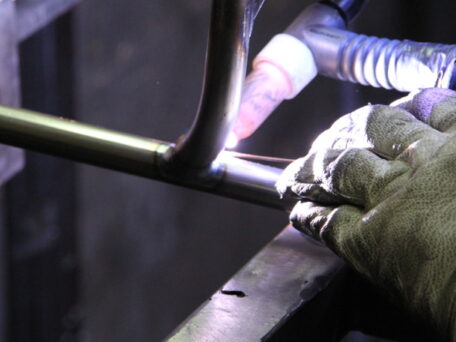
For high-quality frames where the joint is in plain view, we weld with TIG. It produces a clean, narrow weld that can optionally be ground flush on premium versions.
Most often we TIG weld with filler wire, on joints prepared by CNC machining or plastic forming. It is a sensible compromise: the strength added by the filler metal is retained, and the look is slim and pleasing to an eye trained for quality.
We also TIG weld without filler (autogenous). The weld cross-section is then thinner, so the strength is somewhat lower. We use this method where appearance matters more than strength, or for light details.
MAG – hidden or deliberately on show
For us, MAG is not just a method “for welds nobody sees anyway”. We choose it in two cases:
The first is practical. Under the seat, in frames that are embedded in foam before upholstering, and anywhere the joint ends up beneath upholstery, the seat or a tabletop anyway, MAG is faster and cheaper, so there is no reason to weld any other way.
The second is a deliberate choice in welding metal frames. In furniture with an industrial, loft, technical or raw look, an expressive MAG weld is part of the design, not something to be hidden. You can see on it that the frame is made of metal, and that character is often exactly what designers are after.
We also choose MAG where strength matters more than the appearance of the joint. The weld is then heavier, needs less preparation and carries more load. In series we weld with it on the ABB robot, which delivers a repeatable weld appearance from the first piece to the last.
Laser welding – for straight sections
Straight sections of tube or profile can be laser welded. The weld is narrow and even. For complex joints in a frame, the laser does not replace TIG, but on long, straight joints it gives a clean result and works quickly.
Brazing – bronze and brass
On premium frames where the joint has to be very smooth and the load is lower, we braze with a bronze or brass filler. After cleaning and grinding, the joint is aesthetic and almost invisible. The strength is lower than with welding, so we do not use brazing in places that carry higher loads. It is also more expensive (heating, filler), so we keep it for details meant to look like one piece, where the end customer will appreciate the work that went into them.
Braze welding – the middle ground
Sometimes neither clean TIG welding nor brazing suits a particular joint. In those cases we use braze welding: it gives more strength than brazing and more control over the appearance than ordinary welding. We use it when the project requires it, not as a standard.
Stud welding
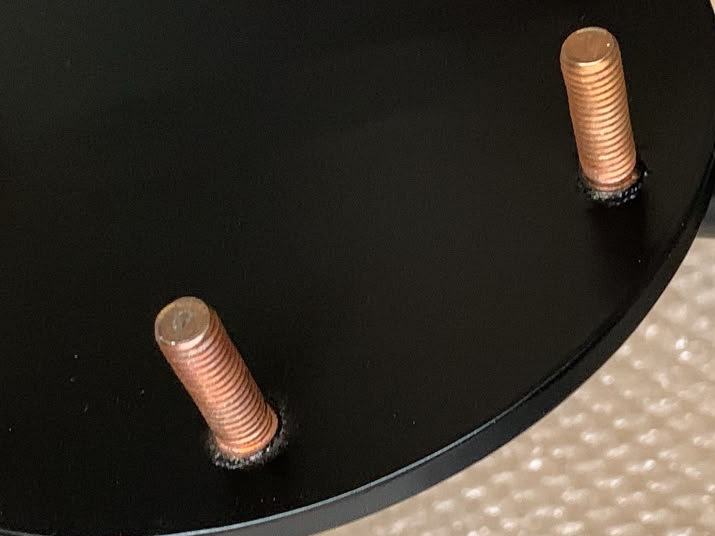
We weld studs, with or without thread, to sheet metal by resistance welding. This is the typical solution for mounting plates, flanges and anywhere something will be bolted on later.
It is quick and repeatable, the weld does not have to run around the entire circumference, and shrinkage distortion of the sheet is lower than with welding
Grinding and sanding – craftsmanship at the end
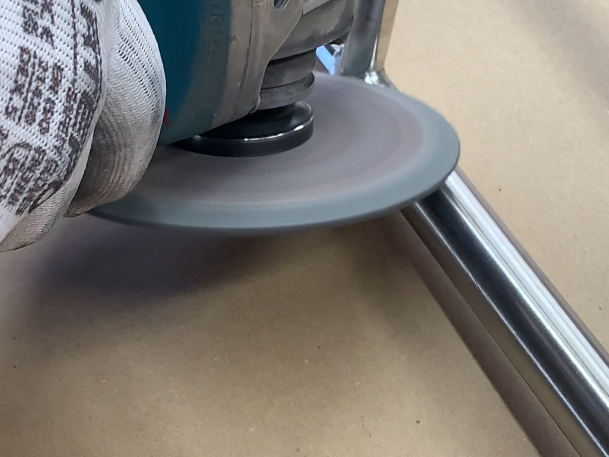
On top-tier versions, when the customer demands the highest joint quality, we grind and sand the frames by hand. It is craftsmanship at the end of the process, not an automated step.
The aim is for the frame to look like one piece rather than a set of tubes. It is tedious and time-consuming, which is why it is chosen only for the most expensive models.
Welding distortion and straightening
Welding puts heat into the metal, and with it stresses. On frames made of small-diameter tubes with relatively thin walls this is clearly visible: after cooling, the welds shrink and pull the structure together, so the frame comes out of welding slightly distorted.
We weld metal frames in industrially made fixtures that last for decades. They hold the parts in the specified position, so successive pieces in a series are repeatable. The fixture limits distortion but does not remove it completely.
That is why we do one more thing after welding that sets us apart: corrective straightening. We restore the symmetry of the frame and reposition the key points so they fit functionally with the parts the customer mounts on the frame, for example seats, backrests or mechanisms. For you, that means the frame fits your parts as designed, not as it ended up after welding.
Which method when
| Situation | Method |
|---|---|
| Large series, repeatable, relatively simple parts | Robot: TIG (Kawasaki) or MAG (ABB) |
| Bent parts with varying weld geometry, lower repeatability | Manual TIG, the welder compensates for tolerances |
| Visible joint, high quality, clean appearance | TIG with filler wire, optionally ground |
| Under the seat, under upholstery or deliberately on show (industrial, loft, raw look), strength more important | MAG |
| Straight section, even weld | Laser |
| Premium, lower load, the joint should look seamless and smooth | Brazing |
| Difficult case in between | Braze welding |
| Stud on sheet metal | Resistance welding |
We determine the method at the start of the project, based on a drawing or a sample. Not every method suits every joint. We advise on how to optimize the design.
FAQ – welding metal frames
Do you weld with robots or by hand?
Both. In large series, Kawasaki (TIG) and ABB (MAG) robots work on Fronius power sources, which we program ourselves. More demanding frames made of bent parts with lower precision are welded by hand by an experienced welder.
Are frames straightened after welding?
Yes. Thin walls and small diameters make frames pull together during welding, so we perform corrective straightening: we restore the symmetry and set the key points so that they fit the parts mounted by the customer.
Does brazing hold as strongly as a weld?
No. The strength of a brazed joint is lower and less predictable than that of a weld, so we only braze where the load is lower, and not in places that carry the whole seat.
How do you ensure quality and repeatability?
We weld in dedicated fixtures that last for decades, so successive series repeat with the same accuracy. The welding is done by specialized welders who work on furniture frames and precision structures every day. After welding, we straighten the frames and correct the welding distortion.
For a quote, a drawing or a photo of the joint is enough.