
Karud has been freeform bending tubes on CNC machines since 2006. A second, newer-generation machine has been running since 2021. Tooling range: Ø14, 16, 18, 20, 22 and 25 mm. The main application is metal chair and furniture frames — sled-base frames, runners, and spatial frames where several radii meet in a single part.
Plant: Karud, Kiełpino, Pomerania, Poland. Frame manufacturing since 1995. Bending, welding, and powder coating under one roof.
Key facts
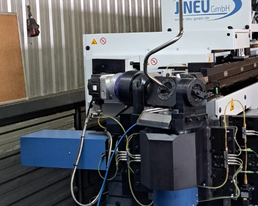
Technology: CNC freeform bending (freeform / Freiformbiegen), J. Neu GmbH machine
- Start: 2006, second line: 2021
- Diameters: Ø14–Ø25 mm
- Materials: precision carbon steel, stainless steel 304 / 316
- Core product: metal chair frames
- Other methods in our fleet: five tube bending technologies
How freeform tube bending works
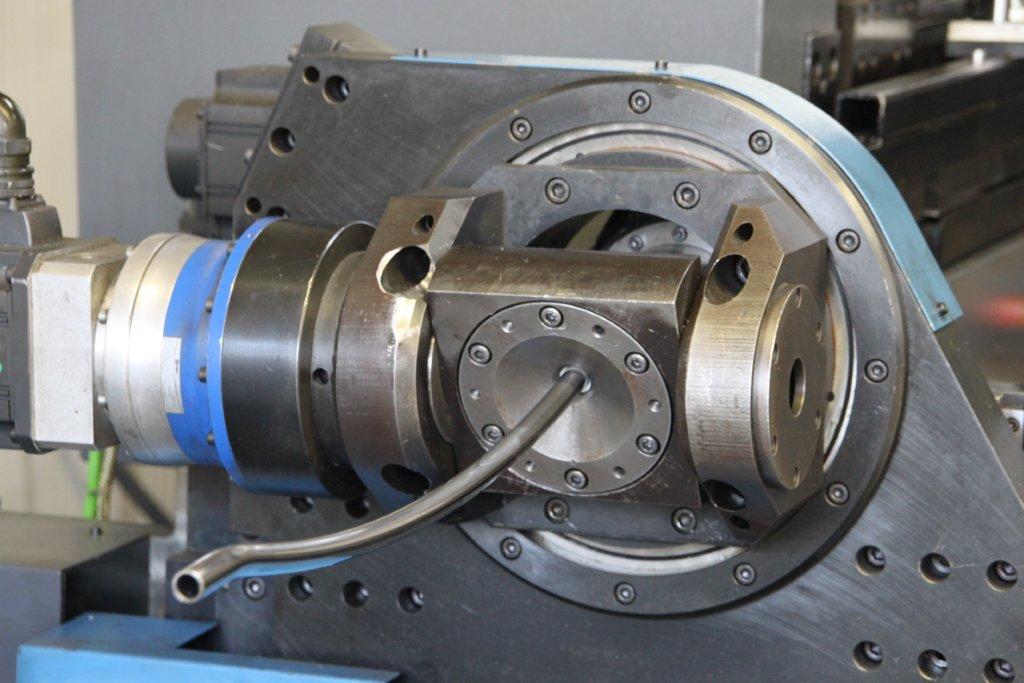
The tube isn’t wound around a single-radius forming roller, as in rotary draw bending. It’s pushed with high force through a bending head (what the industry also calls a mobile bending die): a fixed section plus a synchronized, CNC-controlled moving die. The radius, angle, and plane (twist) of the bend result from the die’s deflection during the feed.
Three things follow from this that matter for frame production:
- One tool set per diameter, not per radius.
- Radii can flow into one another with no straight section between them.
- A full 3D shape can be closed in a single cycle — typical for sled-base frames and frames with a curved backrest.
In rotary draw bending, each different bend radius usually needs its own die (roller) plus a full set of tooling for that radius. For a leg with several arcs, the tooling investment for rotary draw machines can be very high. Freeform bending doesn’t require this. That said, a tight radius on a thin wall is still better suited to rotary draw bending — which is why we keep both methods in-house.
Where the technology comes from
Freeform tube bending didn’t come from last season’s machine catalogue. In the late 1980s, researchers in Japan described how to form a tube by pushing it through a moving head instead of bending it around a fixed roller. In the 1990s the concept went into production under the Nissin brand. In Europe it was taken up and developed further by the German company J. Neu GmbH, which first distributed the Japanese-built machines and later began building its own. Both of our machines run on Mitsubishi controls — J. Neu GmbH has equipped its machines this way for decades.
These machines were first used to build furniture frames and chassis — precisely because a single tool can combine several arcs and a shape in three dimensions on one part. It wasn’t until the early 2000s that the automotive industry took an interest in the method, which is where the tighter dimensional requirements — and the impression that this is “an automotive technology” — come from. Its roots, however, are in furniture manufacturing.
The same story appears in trade press on both sides of the Atlantic. The German publication Blechonline covers the technology’s Japanese origins, its development at Neu since the 1990s, and its early use mainly for furniture. Meanwhile, a 2010 article in the US trade magazine The Fabricator describes it from a shop-floor perspective: a tube through a single head, several radii with no straight section between them, and a tool change only when the diameter changes — on a Nissin bending machine.
The same bending discipline is in use in Japan, Germany, and the US alike.
Our first machine was commissioned in 2006, the second in 2021. That’s twenty years of programming experience and hands-on knowledge of how a tube behaves during bending, what corrections need to be made, and what can and can’t be formed from it. We keep building on that knowledge with every new project — given the nature of our production, most projects are one-of-a-kind and require testing the specific combination of material, tooling, and process. A machine can be bought quickly. Twenty years of experience can’t.
Why it matters for frames
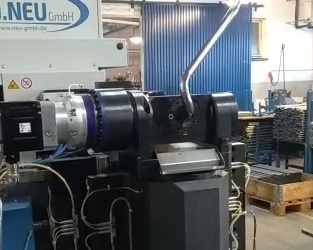
A sled-base chair frame is usually one continuous tube: several radii, a curve in three dimensions, straight sections, and often a kick-up for stacking. In rotary draw bending, that combination means a full set of dies and multiple tool changes. In freeform bending, it’s one tool set per diameter and one program.
What happens to the design matters just as much. The shape isn’t locked into a set of forming tools. A radius, a twist, or a stacking kick-up can be adjusted in the program without ordering new tooling. With rotary draw dies, every such change means touching the tooling itself. When you’re running a series of variants, or fine-tuning a line with a designer, that difference shows up immediately.
When to use freeform tube bending — and when not to
The method makes sense wherever several radii meet on a single tube and the shape moves through three dimensions. Typical examples: sled-base frames, runner-type bases (double sled, skid frames), multi-arc frames, backrests, headrests. It also works well when moving from prototype to series production — without assembling tooling for every radius — and for geometry variants within the same diameter.
Use more caution, or avoid it, with very tight radii on thin walls. A mandrel, which supports the tube from the inside, performs better there. The same applies when the cross-section needs to stay as round as possible after a tight bend, or when the part is a single elbow with one radius. In those cases we use a different method from our fleet.
We work out the right approach together at the start of the project. A drawing, a STEP file, or a physical sample is enough to begin.
Tooling
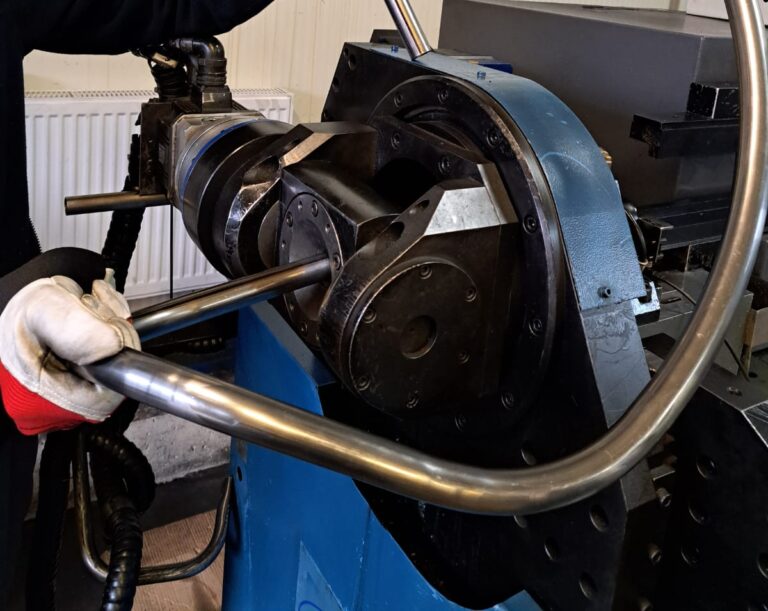
We work with Ø14, 16, 18, 20, 22, and 25 mm. Choosing a diameter isn’t just about appearance. A thinner tube looks lighter but is less rigid (or, depending on the application, more flexible/springy as an advantage); a thicker tube stiffens the frame but changes its silhouette and weight.
| Diameter | Typical use |
|---|---|
| Ø14 | Footrests, headrests, cross-bars, armrests, backrests. Also runner-type frames (double sled, skid frames). |
| Ø16 / Ø18 | Often visually light four-leg frames and stools. Also used as sub-assemblies within larger frames. |
| Ø20 | Mainly four-leg frames. The middle of the range — neither delicate nor heavy-duty. |
| Ø22 / Ø25 | Cantilever metal chair frames, main chair frames, and armchair bases. |
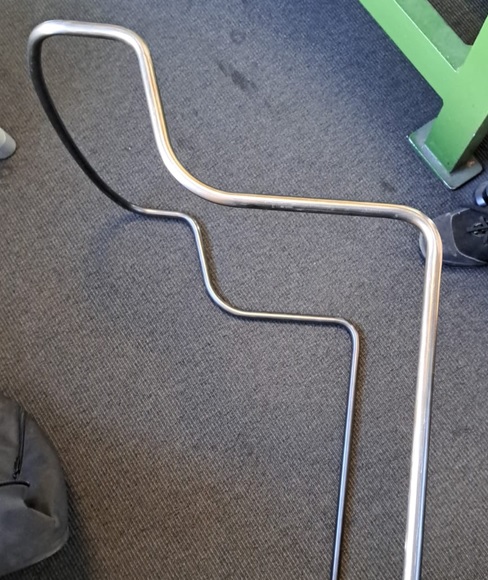
Wall thickness and steel grade are matched to the radius and to the load the seat needs to carry — not the other way around. We advise on material selection.
Not just chairs
Furniture frames are our everyday work, and this bending method is well suited to them. The bending head doesn’t know whether the part it forms is heading to an upholsterer as a sub-assembly, or is a finished product for someone else entirely.
On these same machines we’ve produced, among other things, a prototype door frame for SAM, Poland’s first electric car (2008), yacht handrails, transport carts, and armchair headrests, along with many other parts. The common thread is simple: the tube needs several arcs, often in three dimensions, and we don’t want to build a separate roller for every radius.
How to place an order
2D documentation, a 3D model (SolidWorks / STEP), or a physical sample — we have a 3D laser scanner. We first check the design for bendability, then produce a prototype, and finally move to series production.
Contact: karud.pl/en · Kiełpino, Długa 61, Poland.
FAQ
What’s the difference between freeform tube bending and rotary draw tube bending?
In freeform bending, the tube passes through a moving head and the radius is set by CNC. In rotary draw bending, the tube is formed around a die of fixed radius, supported from the inside. Freeform: multiple radii on one tool, faster for complex geometry. Rotary draw: better for tight arcs and thin walls.
Since when has Karud offered freeform tube bending?
Our first machine has been running since 2006. A second line has been running since 2021 — two lines mean production continuity.
What tube diameters do you bend using the freeform tube bending method?
Ø14, 16, 18, 20, 22 and 25 mm.
Is freeform bending suitable for a sled-base chair frame?
Yes. A sled base is a textbook part for this method: one continuous tube, several radii, a three-dimensional shape. Choosing the right material is the key first step.
Does every radius need its own tool?
No. One tool set covers a whole diameter.
Are you limited to the diameters listed in the table?
No — if the customer is willing to make the considerable investment in a dedicated tool set for a non-standard diameter, and allows for the extra lead time needed to produce it.
Do you bend stainless steel?
Yes, grades 304 and 316, alongside precision carbon steel.
Can you work from just a CAD model or a sample chair?
Yes. We can start from a CAD file or a laser scan, then produce documentation and a prototype.
Where is your plant located?
Karud, ul. Długa 61, 83-307 Kiełpino, Pomerania, Poland.